
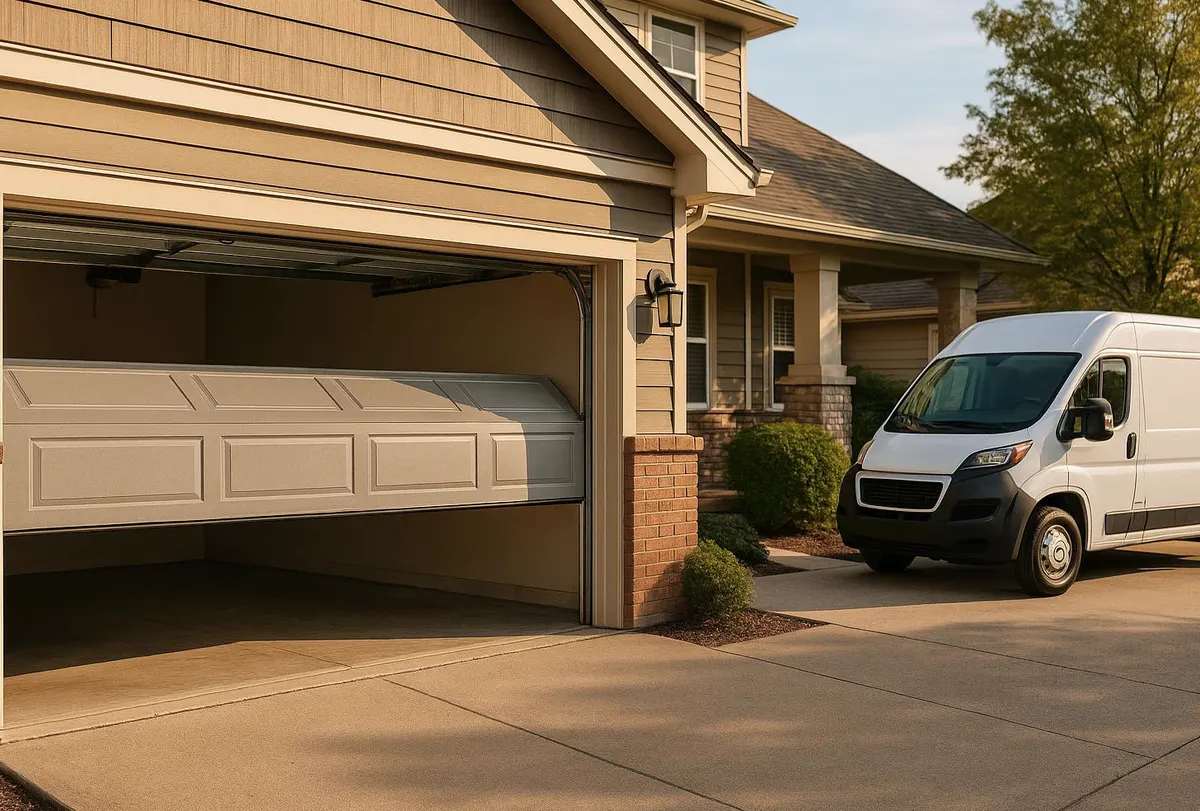
You hit the opener button on a cool November morning and the door groans, jerks up an inch, and stops. Or it lifts, but slower than usual, with a low straining hum from the motor. Maybe you try lifting it by hand and the bottom edge feels like it's glued to the slab. If you grew up somewhere with real winters, your first thought might be "frozen." In Fernandina Beach, it's almost never actual ice. What you're feeling is usually moisture, salt air, and stiff hardware all showing up at once on the first genuinely cold snap of the season.
What You're Likely Noticing
A sluggish or stuck garage door on Amelia Island tends to show one or more of these signs:
- The door stalls partway through its travel, up or down, and the opener motor sounds like it's working harder than normal
- The bottom weatherstripping seems stuck to the concrete floor, resisting the first few inches of lift
- The door is noticeably heavier when lifted manually than it was a month ago
- Movement is jerky or uneven instead of smooth, sometimes with a grinding or squealing sound
- The safety sensors cause the door to reverse before it fully closes, even though nothing is blocking the path
None of these mean the door is broken beyond repair. They're symptoms, and like any symptom, the fix depends on finding the actual cause rather than just forcing the door open and hoping it works itself out.
Checking the Causes, in the Order a Technician Would
1. The Bottom Seal and Threshold
This is the first thing to rule out, and it's the one that genuinely mimics "frozen to the ground." Overnight humidity and morning dew can leave a thin film of moisture on the garage floor. If the rubber weatherstripping along the bottom of the door has swollen slightly from absorbing humidity, or if there's a buildup of dried pollen, grit, or rust dust from salt air, the seal can tack itself to the slab almost like an adhesive. The fix here is simple: clean the threshold and the full length of the seal, check whether the weatherstripping has swelled or cracked, and replace it if it has. This alone solves a surprising number of "stuck door" calls in coastal Florida homes, especially garages that sit close to the water or get direct morning sun followed by overnight cooling.
2. The Tracks
Next, a technician runs a hand along both vertical and horizontal tracks feeling for grit, old grease that's turned gummy, or surface rust. Salt-laden air accelerates oxidation on steel tracks faster than it would inland, and rust creates friction the rollers have to fight through. Cold, thickened lubricant from a cheap all-purpose spray can also gum up in the track channel overnight. The fix is to clean the tracks with a rag and mild degreaser, check alignment with a level, and apply a proper garage door lubricant made for the hardware, not WD-40, which attracts dust rather than repelling it.
3. Rollers and Hinges
Nylon rollers can stiffen slightly in cooler temperatures, and steel rollers near the coast are prone to surface rust on the bearings, which makes them spin less freely. A technician checks each roller for flat spots, cracking, or resistance when turned by hand, and inspects the hinges for the same rust buildup. Worn rollers get replaced rather than lubricated, since lubricant won't fix a roller that's already egg-shaped or seized at the bearing.
4. Springs
Torsion and extension springs lose a bit of flexibility in colder air, and if there's any rust forming on the coils from humidity exposure, that stiffness is worse. A door that feels unusually heavy to lift by hand, especially if it used to balance evenly at the halfway point and no longer does, points to spring fatigue or imbalance rather than a simple track issue. This is not a DIY adjustment. Springs are under heavy tension and an improperly adjusted or broken spring can cause injury. A technician will check spring tension, look for rust pitting that weakens the coil, and recommend replacement if the spring is near the end of its cycle life or showing corrosion damage.
5. Cables
While checking the springs, a technician also inspects the lift cables at the bottom bracket and at the drum. Salt air corrodes cable strands from the outside in, so fraying often starts where you can't see it unless you're looking closely. A cable that's starting to fray won't necessarily snap on the first cold morning, but it will cause uneven lifting, which reads as "sluggish" or "off track" to the homeowner.
6. The Opener Itself
Last on the list, because it's usually not the real problem, is the opener unit. Cold can thicken the gear lubricant inside an aging opener, and if the limit settings have drifted, the door may stop short or reverse unexpectedly. A technician checks the force and limit settings, inspects the drive gear or belt for wear, and confirms the sensors are aligned and not fogged over from morning humidity, which is a common false alarm near the coast.
When to Call Precision Garage Door of Fernandina Beach
If your door is sticking at the bottom, moving unevenly, or straining the opener, it's worth having it looked at before the next cold snap turns a minor annoyance into a stuck door at 6 a.m. Our technicians work through these checks in the same order, starting with the cheapest and most common fixes first. A Garage Door Maintenance & Tune-Up covers the tracks, rollers, hinges, and lubrication that solve most seasonal stiffness, while Cable & Roller Replacement addresses the salt-air corrosion that's common on Amelia Island homes close to the water. If the issue turns out to be spring-related, we'll explain exactly what we find and what the repair involves before any work starts.
If your garage door is giving you trouble this season, call Precision Garage Door of Fernandina Beach. We serve Fernandina Beach, Amelia Island, Yulee, Callahan, Hilliard, and the surrounding Nassau County area, and we'll get it diagnosed and fixed right the first time.